
CPDLC Ground Testing Has a New Benchmark
and Most MROs Haven’t Caught Up Yet
By Malcolm Lane | Business Development & Distribution, Europe & Africa | Laversab
Flight plans above FL285 are being rejected. Not logged, not flagged for review — rejected. Since November 2025, Eurocontrol’s Integrated Flight Plan Processing System (IFPS) actively turns back any filing that doesn’t declare either ATN VDL Mode 2 capability (J1 in Field 10) or a valid exemption (DAT/CPDLCX in Field 18). Eurocontrol confirmed this at a February 2025 webinar. This is enforcement, not guidance.
For most commercial operators and the MROs that keep their fleets airworthy, CPDLC is no longer a background requirement — it is front-line operational infrastructure. And yet the approach to maintaining and verifying that infrastructure has barely moved in a decade.
That changed in October 2025. The question is whether the people responsible for CPDLC-equipped aircraft know it yet.
The Testing Gap Nobody Talks About
Ask an avionics technician how they verify an aircraft’s transponder after a line replacement unit swap, and they’ll point to a ramp test set. Probably one of two or three they have on the shelf. The process is well-understood, well-tooled, and well-documented in the AMM.
Ask the same technician how they verify a CMU replacement before the aircraft returns to service on CPDLC, and the answer is almost always a variation of the same thing: a live network connectivity check through the Communication Service Provider — ARINCDirect, Satcom Direct, or similar. Log on, get a reply, tick the box.
The problem is that a CSP check confirms connectivity to a remote server. It does not verify the full ATN protocol chain — the VDL Mode 2 physical layer, the ATN network layer, Contact Management logon, CPDLC message exchange, or response timer compliance. It is dependent on VDL2 network coverage at the location where the test is performed. And it produces no independently documented record of the verification.
Until October 2025, there was no portable ramp test set that could do better. There is now.
What Ground Verification Actually Requires
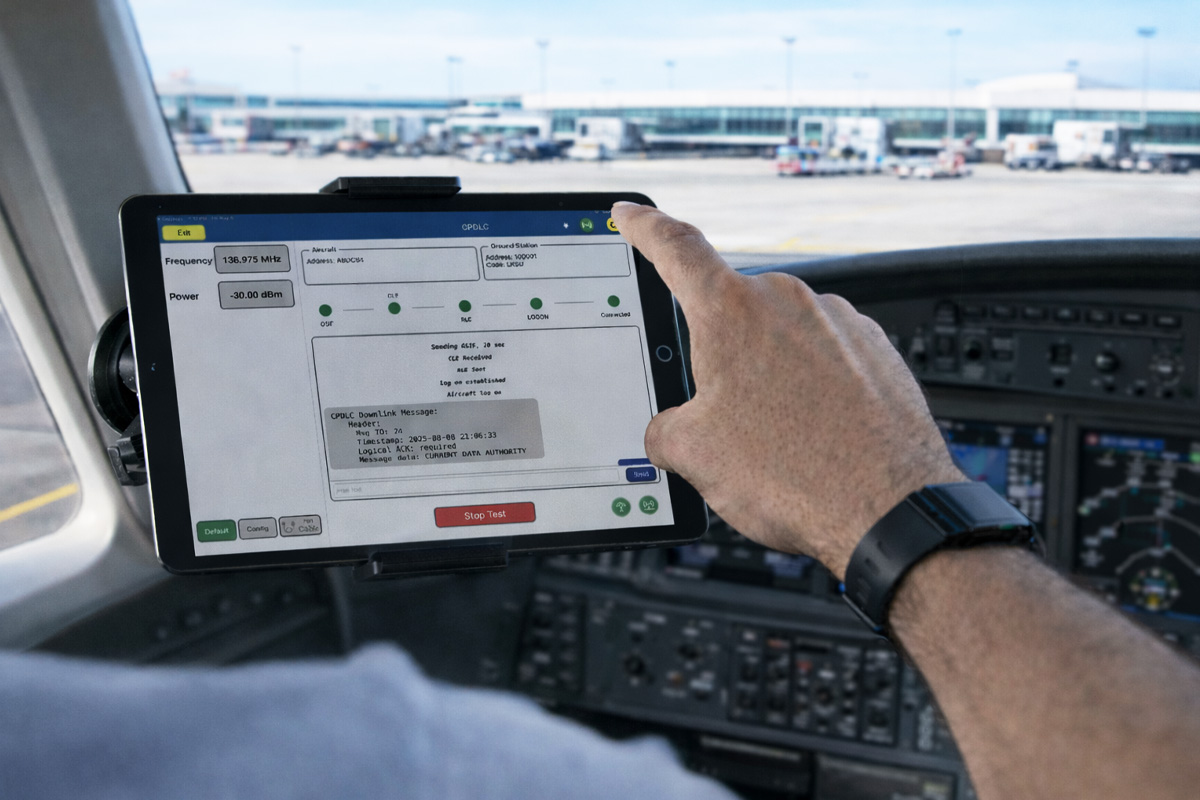
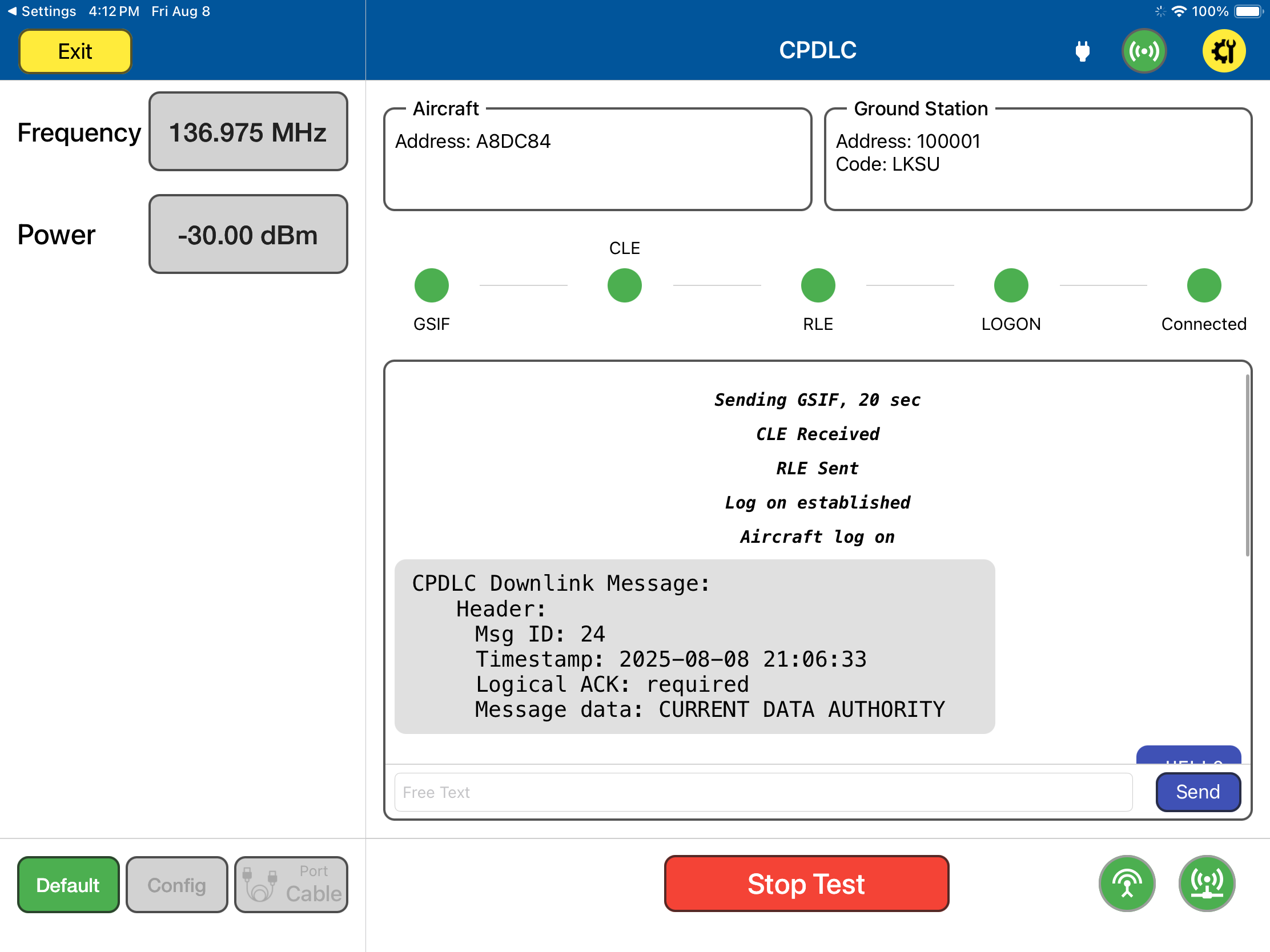
CPDLC is not a radio signal you can check with an RF parametric tester. It is a multi-layer digital communications protocol. Verifying it properly means emulating a complete VDL Mode 2 ATN ground station — generating the physical layer signal, advertising ATN support, completing a full CM logon with the aircraft’s CMU, exchanging uplink and downlink messages through the CDU/MCDU, and monitoring response timers — all from the hangar floor, with no external network connection required.
This is what the ARTS-7000 CPDLC option (P/N 121-0132) does. To our knowledge, it is the only portable all-in-one avionics ramp test set in the world that offers this capability. That is not a comparative marketing claim. It is a description of where the market currently stands.
The Compliance Exposure Is Real, and It Accumulates
Eurocontrol’s datalink performance monitoring tracks Provider Abort rates by operator and aircraft avionics configuration. The network performance target is 1 PA per 100 hours of CPDLC session time. Avionics configurations that exceed this threshold risk removal from the Logon List, and an aircraft whose configuration is removed from the Logon List cannot log on in ANSPs that enforce it.
Critically, Logon List eligibility applies by avionics configuration, not by individual aircraft. A CMU software issue generating elevated PA rates on one airframe can affect every aircraft in a fleet carrying the same configuration.
A CMU is replaced. A CSP connectivity check passes. The aircraft returns to service. Two days later, an ATN logon failure generates a PA against that configuration in Maastricht upper airspace. The maintenance technician had no way to know the CMU was not performing correctly at the protocol layer, because no one ran a protocol-layer test.
The ARTS-7000 closes that gap. The test takes minutes. The result is documented and exportable.
The Two-Box Problem
Traditional avionics ramp test sets are built on RF-parametric hardware architectures — designed to generate and measure radio frequency signals. CPDLC testing is a fundamentally different discipline. It requires emulating a complete multi-layer digital communications protocol stack. These are not the same problem, and the same hardware does not solve both.
For any organisation that currently relies on a conventional ramp test set and needs to add CPDLC ground verification capability, the only available path — short of the ARTS-7000 — is a separate, dedicated datalink tester. That instrument covers datalink only. It does not test transponders, ADS-B, TCAS, DME, Nav/Com, ILS, or VOR. It does not replace a ramp test set. It adds to one.
The result is two instruments, two calibration cycles, two procurement processes, two training programmes, two support relationships, and two lots of storage and management overhead. For a multi-station MRO, that overhead multiplies across every location.
ARTS-7000 users add CPDLC as a software licence at their next calibration visit. One platform. One calibration cycle. One support relationship.
Why This Matters for MROs Specifically
The mandate environment creates a clear and growing service requirement. Every CPDLC-equipped aircraft operating above FL285 in European airspace needs confident, documented ground verification after any maintenance event that touches the communications chain — CMU or VDR replacement, software updates, avionics modifications, airframe reconfigurations. Business aviation completion centres and MROs servicing CPDLC-equipped business jets face the same requirement, with the added dimension that their customers operate on reputation as much as schedule.
The ARTS-7000 CPDLC option positions an MRO to offer something no ramp-test-set-only competitor can: a single portable unit that runs a complete CPDLC protocol verification alongside transponder, ADS-B, TCAS, ILS, DME, Nav/Com, GPS simulation, VSWR, and — uniquely — integration with the Laversab 6200 Series Air Data Test Set for combined air data and avionics testing from a single iPad interface.
For organisations building formal CPDLC procedures into their approved maintenance documentation, this is the benchmark tool that makes it possible.
The Enforcement Is Already Here
There is a version of this conversation that might have made sense twelve months ago: wait and see how enforcement develops, see if competitors bring competing solutions to market, evaluate whether the customer base actually demands it.
That window closed in November 2025. Enforcement is active. Flight plans are being rejected today. The organisations that have already adopted the ARTS-7000 CPDLC capability are already operating at the benchmark. The question for everyone else is not whether this matters — it is how long they want to be behind the organisations that moved first.
The ARTS-7000 CPDLC option (P/N 121-0132) is a software licence for Nav/Com module units. For technical specifications, capability details, or to discuss CPDLC testing requirements for your organisation, contact Laversab at sales@laversab.com or visit laversab.com/aviation.